


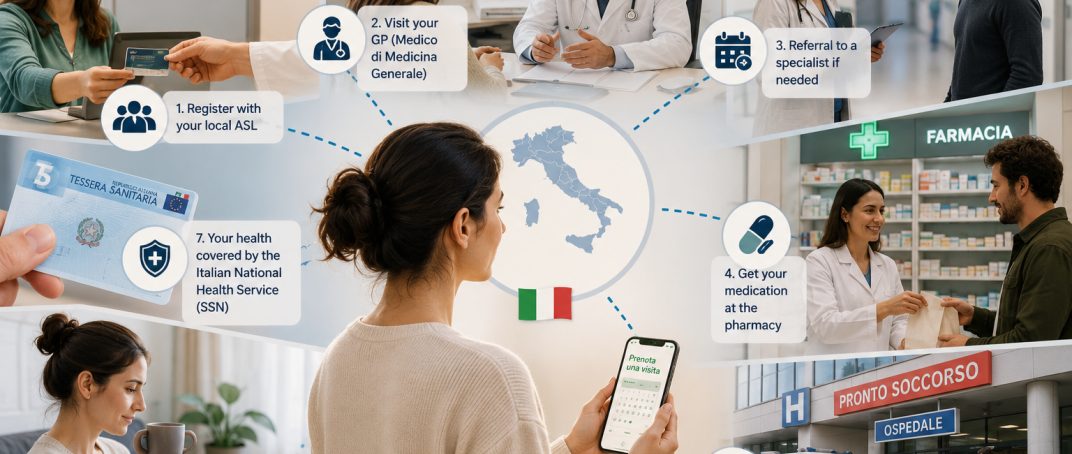
Italian healthcare is universal on paper and regional in practice. People who move here work that out quickly: the useful question isn’t whether Italy has good medicine, it’s what you personally have to do, in this particular city, to be looked after.
This guide sets out the steps in order: how to register with the national health service, what it costs when registration isn’t automatic, how to choose a family doctor, when you pay a co-payment, and what to do at night and on public holidays.
How the national health service is organised
The SSN (Servizio Sanitario Nazionale) is tax-funded and covers everyone resident in Italy. Administration, however, is regional: twenty regions run their own hospitals, local health authorities and waiting lists.
The practical consequence is that waiting times, co-payments and exemptions differ from region to region. A scan you can book within two weeks in Emilia-Romagna may take eight elsewhere, and the co-payment for the same procedure won’t be the same either.
The document that opens every door is the tessera sanitaria, the health card that also carries your tax code. You need it to book appointments, to collect prescriptions and to access your electronic health record.
Who is entitled to care, and how to register
Compulsory registration
Registration with the SSN is compulsory — and free, because it is covered by contributions — for holders of a residence permit for employed or self-employed work, family reunification, asylum or protection, and for EU citizens who work or hold permanent residence rights.
You register at the ASL (local health authority) for your municipality, with:
ID and residence permit (EU citizens: proof of registration)
Tax code (codice fiscale)
Proof of residence or a declaration of address
Employment documents, where that is the basis for registration
Registration automatically produces the tessera sanitaria and opens the choice of a family doctor.
Voluntary registration
People outside the compulsory categories — for instance holders of an elective residence permit, and some students — can register voluntarily by paying an annual contribution. Since 2024 the amounts are:
€700 for students with no income other than a scholarship
€1,200 for au pairs
at least €2,000 in all other cases, calculated as a percentage of income
The €2,000 floor isn’t arbitrary: it matches the SSN’s average annual spend per registered person. One detail catches families out: the reduced rate for students and au pairs does not apply if you have dependants — in that case the ordinary calculation applies, with the same €2,000 minimum.
The alternative to voluntary registration is private health insurance, which covers differently and almost never includes a family doctor.
Tourists and short stays
EU citizens use the EHIC, which entitles them to necessary care during a stay on the same terms as residents. Visitors from outside the EU need travel insurance: emergency departments will treat you regardless, but the care is chargeable.
The family doctor and the paediatrician
The medico di medicina generale — everyone calls them the medico di base — is the entry point to the system. They consult free of charge, prescribe medication and tests, issue certificates and write the referral (impegnativa) you need for a specialist. Without that referral, a specialist appointment in the public system is charged in full.
You choose your doctor at the ASL or online through your regional portal, from the list of doctors with places available in your district. Changing doctor is possible at any time and needs no justification.
Children up to six are followed by a pediatra di libera scelta. Between six and fourteen the family chooses between the paediatrician and the family doctor; at fourteen the switch becomes the rule, with extensions to sixteen in particular cases.
The known weak point is availability: in many cities few doctors have open lists and surgeries are crowded. For anything that doesn’t need a physical examination — making sense of a symptom, reviewing a treatment, reading a report — an online consultation with a GP settles it without the queue, and a prescription renewal takes a day.
Co-payments and exemptions
Not everything in the SSN is free. The ticket is the patient’s share of the cost for specialist appointments, diagnostics and some medicines; the amount is set regionally.
Exemptions exist for:
Age and income (under-sixes and over-65s in households below an income threshold)
Recognised chronic and disabling conditions
Pregnancy, for the care pathways provided
Rare diseases
An exemption doesn’t appear by itself: you apply at the ASL or self-certify, and it carries a code the doctor writes on the referral. It is worth checking before booking — on a single test the difference runs to tens of euros.
Private healthcare
Italy’s private sector is large, and people use it mainly to shorten waits. Many facilities are accredited: they work for the SSN, so with a referral from your family doctor you pay only the co-payment. The same facility, seen privately, will fit you in within days at the full rate.
Indicative prices:
Private specialist appointment: €100–150
Doctor’s appointment without a referral: €50–100
Basic blood tests: from €20
Private emergency department: €100–200
Supplementary health policies generally start around €400 a year for an adult and cover specialists, diagnostics and hospital stays. Many employment contracts already include one through a sector health fund — worth checking before buying your own.
Emergencies
The numbers
112 is the single European emergency number, free and active nationwide: the operator dispatches an ambulance, the fire service or the police. Some regions still run 118 for medical emergencies; if you aren’t sure which to use, call 112.
For situations that aren’t emergencies but can’t wait until Monday, there is the guardia medica (continuità assistenziale): it operates at night, at weekends and on public holidays, sees patients at the surgery or at home, and can prescribe.
The emergency department and priority codes
Emergency departments treat by severity, not by arrival time. Since 2019 national guidelines have replaced colours with five numeric codes: 1 is an absolute emergency seen immediately, 2 is urgent and assessed within fifteen minutes, 3 is deferrable urgency within an hour, and 4 and 5 are minor. Many regions still show the colours alongside.
Arriving with a low code can mean many hours of waiting, and in some cases a co-payment for inappropriate use. So when a symptom worries you but doesn’t look serious, it is more sensible to speak to a doctor first: if you need the emergency department they will tell you, and if you don’t, you have saved yourself a night in a corridor.
Pharmacies
Italian pharmacies sell painkillers and antipyretics, antihistamines, remedies for mild digestive problems and rapid tests without prescription. Antibiotics, stronger anti-inflammatories, anxiolytics and hormonal treatments all require one.
SSN prescriptions are dematerialised: the doctor generates an electronic memo and the pharmacy needs only the code together with your tessera sanitaria. Private prescriptions, including PDFs, are equally valid but carry no subsidy.
Outside opening hours a duty pharmacy rota operates: the list is posted in every pharmacy window and published on the ASL websites. Pharmacists in Italy are qualified health professionals, and for a minor complaint they are often the right first stop.
What to sort out before you need it
The codice fiscale, which you need even before the health card
SSN registration — or insurance, if you aren’t entitled
Your choice of family doctor, rather than leaving it until the first illness
Numbers in your phone: 112 and your district’s out-of-hours service
Any exemptions you qualify for
The Italian system works well once it is set up and becomes exhausting when you enter it in a hurry, with a fever and no health card. Half a day of paperwork at the start buys months of calm afterwards.

Commenti
Sii il primo a commentare questo articolo.
Accedi per lasciare un commento
Il tuo commento sarà visibile agli altri lettori dopo la moderazione.